ShelfOps User guide
Merchant operations handbook

ShelfOps Inventory Buying Guide

From Shopify sync to auditable inventory control

EnglishVersion 1.0

Welcome to ShelfOps

ShelfOps is an inventory buying workspace embedded in Shopify Admin. It brings supplier information, reorder planning, purchase orders, receiving, transfers, stocktakes, supplier bills, labels, and audit records into one operational flow.

This guide is written for buyers, inventory managers, receivers, and store owners. You do not need technical or API knowledge. The screenshots use synthetic preview data; your installed app shows your own Shopify products, locations, and inventory.

The operating model

ShelfOps separates planning from inventory changes. You can sync, map suppliers, calculate reorder quantities, create draft POs, receive deliveries, run counts, and review transfers in preview mode. A Shopify inventory update can happen only when the relevant deployment availability, Shopify permission, store choice, and exact-operation confirmation all pass.

Stage What ShelfOps does What you decide
Sync Imports Shopify variants, locations, and inventory When to refresh the workspace
Map Connects variants to suppliers and buying rules Which supplier and constraints are correct
Buy Calculates or records purchase quantities Which lines and quantities enter a draft PO
Receive Classifies delivered units and saves a receipt preview Whether to commit that exact receipt
Count Saves blind or visible counts and compares with Shopify Whether to commit the frozen adjustment preview
Audit Records actions, exports, and outcomes How to investigate and reconcile exceptions

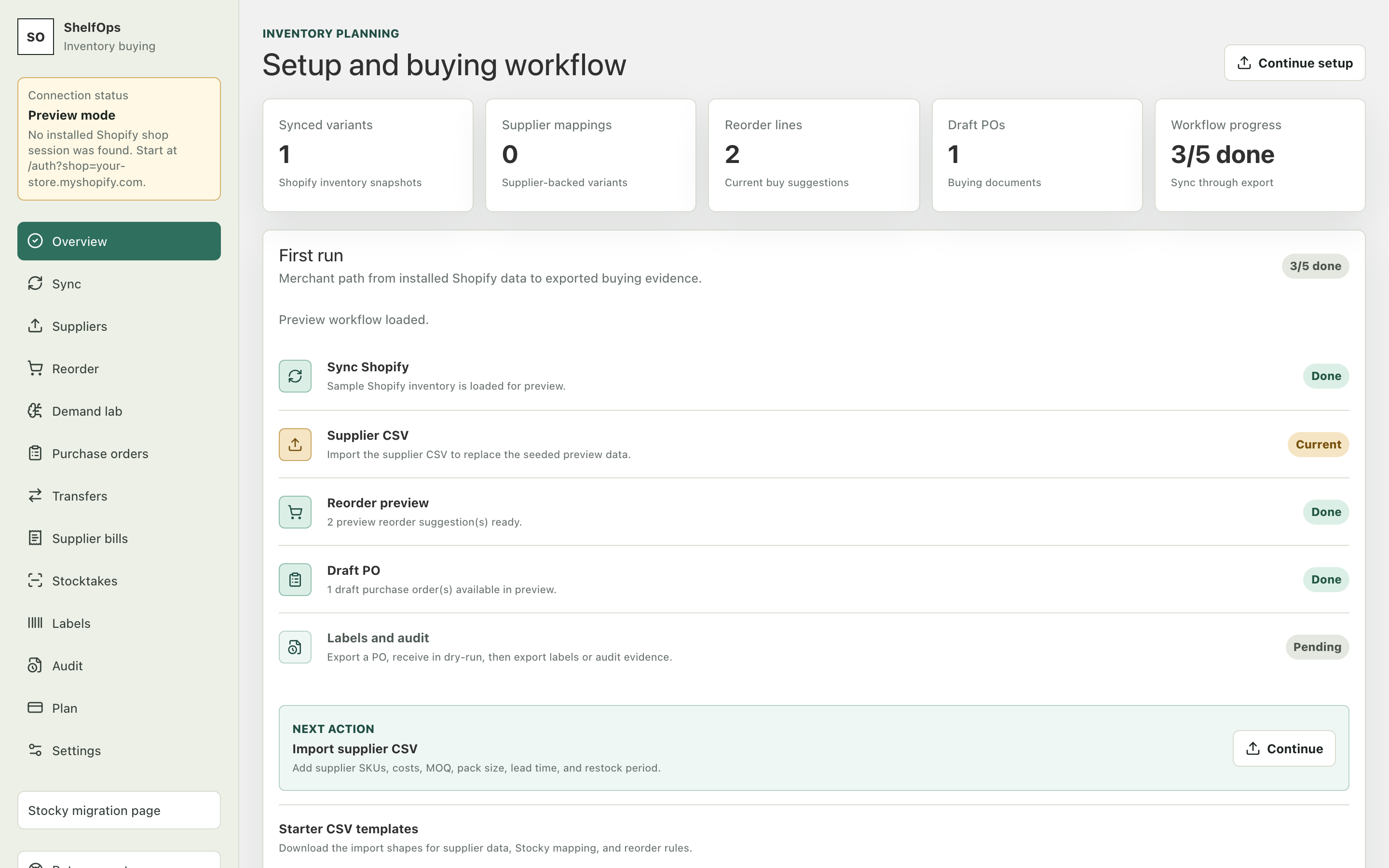
ShelfOps Overview showing setup progress and the first buying workflow
Overview keeps setup status and the next operational step together.

Get started

1. Install, trial, and access

1. Install, trial, and accessShelfOps opens inside Shopify Admin after the store has been granted installation access. The plan includes a 45-day trial, then costs $29 USD month...

2. Navigate and complete first setup

2. Navigate and complete first setupThe left navigation follows the inventory workflow: Overview shows readiness and the next action. Sync imports Shopify operational data. Supp...

3. Sync Shopify data

3. Sync Shopify dataSync creates the Shopify data foundation used throughout ShelfOps: product variants, locations, and inventory snapshots. The initial import is asynchronous,...

4. Import suppliers and buying rules

4. Import suppliers and buying rulesSupplier mappings tell ShelfOps where a variant is purchased, what it costs, and how the supplier accepts orders. Download the template from...

Plan and buy

5. Create reorder suggestions

5. Create reorder suggestionsReorder combines inventory position, buying rules, and demand evidence to propose purchase quantities. The page also accepts manual quantities, whic...

6. Understand Demand Lab availability

6. Understand Demand Lab availabilityDemand Lab is ShelfOps' forecasting and buying-decision workspace. It is intentionally separate from the stable rule-based Reorder workflow....

7. Work with purchase orders

7. Work with purchase ordersShelfOps purchase orders are internal operational records. They group one supplier, one destination location, and explicit line quantities. Export th...

Inventory operations

8. Receive a purchase order

8. Receive a purchase orderReceiving records what physically arrived. Accepted, damaged, rejected, and missing quantities remain separate. Only accepted units are eligible to in...

9. Plan and track inventory transfers

9. Plan and track inventory transfersTransfers track a planned movement from one active synced Shopify location to another. Dispatch and destination receipt are separate operati...

10. Run stocktakes

10. Run stocktakesStocktakes support full inventory counts and filtered cycle counts. Counts persist as you work, can be blind, can require a second count, and freeze an exact c...

Finance and records

12. Print labels and export records

12. Print labels and export recordsLabels represent newly accepted physical units from normal receipts. Use them for receiving packets or product handling; correction receipts d...

13. Review audit history

13. Review audit historyAudit records show who or what initiated a supported action, when it occurred, the affected resource, and the recorded outcome. Use Audit before repeatin...

Safety and help

14. Inventory change controls

14. Inventory change controlsSettings keeps three independent controls: receiving writeback, stocktake writeback, and transfer writeback. Every store starts conservatively. Prev...

15. Troubleshooting

15. TroubleshootingThe app opens outside Shopify or shows an authentication errorReturn to Shopify Admin > Apps > ShelfOps. Confirm you selected the correct store and that...

16. Glossary and support

16. Glossary and support Term Meaning Accepted Units physically accepted and eligible for inventory increase Available Shopify inventory available for sale; Shopify already acco...

17. End-to-end operating checklist

17. End-to-end operating checklistUse this checklist for the first complete buying cycle or for training a new operator. Open ShelfOps from the correct Shopify Admin store. Veri...